
Walter Kimball, Senior Health and Science Editor.
It is 7:40 on a Tuesday, and there is no time for a wash day. You are standing in front of the bathroom mirror with three half-used cans of dry shampoo lined up on the shelf, none of them quite right: one leaves a chalky cast at the roots, one smells like a candle you did not ask for, one seems to do nothing at all by noon. You type some version of the same question into your phone every few months — which dry shampoo actually works — and get back a wall of listicles that all recommend something different.
Here is the useful fact to start with: dry shampoo does not clean hair. It never has. It is a starch or clay that absorbs surface oil and light debris, the way a paper towel lifts grease off a countertop rather than dissolving it. Once you understand that one mechanism, most of the marketing on the shelf becomes easy to sort from the substance, and the rest of this guide is about how to do that sorting for yourself.
- Dry shampoo absorbs oil, it does not remove it — the residue stays in your hair until you brush it out or wash it, which is why application technique matters more than any single ingredient.
- Powder-based formulas outperform aerosols on visible white cast for darker and deeper hair shades, according to formulation chemists, because particle size and pigment matching drive the residue you see, not the propellant.
- Overuse is the most common mistake, and it can visibly worsen scalp buildup and irritation over weeks, according to dermatologists, because product is layering on product rather than being cleared.
What Dry Shampoo Is Actually Doing To Your Hair
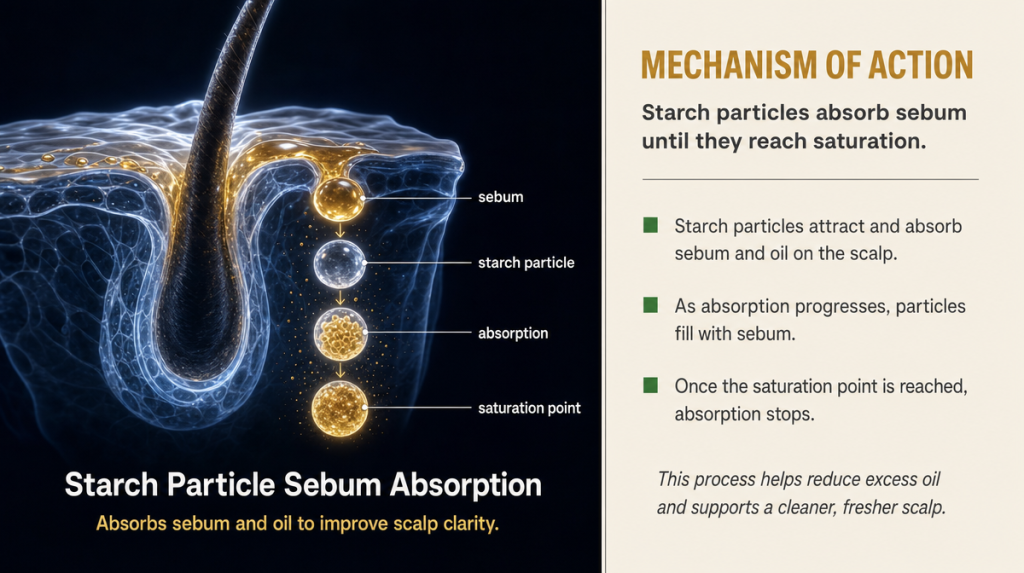
Strip away the fragrance and the aerosol hiss, and dry shampoo is a simple physical absorbent: usually a rice, corn, or oat starch, or a fine clay such as kaolin, dusted or sprayed onto the scalp and roots. Sebum, the natural oil your scalp produces, is what makes day-two or day-three hair look flat and stringy. The starch particles are porous and slightly charged, so they grab onto that oil the way a sponge grabs onto water spilled on a countertop.
“The particle is not dissolving the oil, it is trapping it on its surface,” said Dr. James Morrison, PhD, a biochemist whose research background is in dermal delivery and formulation science. “Once the particle is saturated, it stops helping, no matter how much more you apply.”
That is the single fact that explains almost every dry shampoo complaint: the flat look that returns by afternoon, the itch that builds by day four, the visible powder that will not brush out. The product has a finite absorbing capacity, and once it is used up, no amount of extra spraying restores it.
Reading The Label Without The Marketing Noise
Ingredient lists on dry shampoo cans are short compared to a serum, which makes them easier to audit. Near the top you are usually looking at some combination of alcohol denat., a starch (rice, tapioca, oat), or a clay (kaolin, bentonite). Alcohol is there to help the propellant carry the powder evenly and to speed drying; it is not inherently bad for hair, but it can be drying to a sensitive scalp with repeated daily use.
Words like “volumizing,” “clean,” and “refreshing” are marketing language, not functional claims, and they are not regulated the way a drug claim would be. What is worth reading closely is the particle description, when a brand bothers to give one: finer, more uniform particles tend to blend into hair more invisibly, while coarser starches sit more visibly on the surface, especially on darker strands.
A fragrance listed simply as “parfum” or “fragrance” can contain dozens of unlisted compounds, which matters mainly for people with a known sensitivity or scalp condition. If your scalp reacts to most fragranced products, that single line is worth more attention than any claim printed in bold on the front of the can.
Matching Formula To Hair Color And Texture
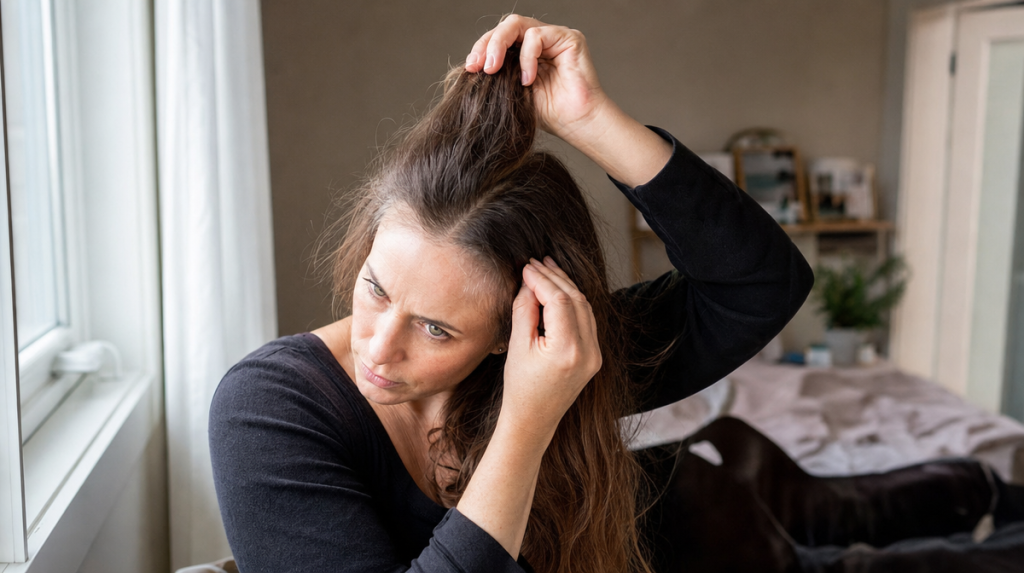
The most common failure with dry shampoo is not a flaw in the product, it is a mismatch between formula and hair shade. Untinted rice or corn starch reads as a faint white or gray dust against dark brown, black, or deep red hair, no matter how well it absorbs oil. Brands have responded with tinted powders formulated for fair, light, medium, tan, and deep shade ranges, using iron oxides or cocoa powder to tint the base starch closer to the hair’s actual tone.
Texture matters too. Fine, straight hair shows dry shampoo residue more readily because there is less surface area to disperse it into; coarser or curlier hair can often hide a slightly visible powder within its natural texture. Aerosol sprays tend to distribute more finely and evenly across the scalp, while powder or loose-formula versions require more careful blending with your fingertips or a brush, but often allow more precise, targeted application at the roots.
A simple self-test: apply a small amount of any new dry shampoo to a section of hair near your part line, wait two minutes, then look at it under natural daylight rather than bathroom lighting. Bathroom vanity bulbs mask cast far more than window light does.
Application Technique: Where Most People Go Wrong
Even a well-formulated dry shampoo underperforms when it is applied incorrectly, and the most common mistake is spraying it too close to the scalp and too far from the roots doing the real work. Holding the can six to eight inches away, rather than pressing it directly against hair, gives the powder room to disperse before it lands, which reduces both visible buildup and wasted product.
The second mistake is skipping the wait. Dry shampoo needs roughly one to two minutes of contact time to absorb oil before you work it in; spraying and immediately brushing through undoes most of the benefit, because the starch has not yet had time to bind the sebum.
The third, and most damaging over time, is layering fresh product onto old residue day after day without ever brushing thoroughly or shampooing it out. “Dry shampoo is a bridge, not a replacement for washing,” said Dr. Claire Dubois, MD, a board-certified dermatologist. “Used for one or two days between washes, it is generally well tolerated. Used continuously for a week or more, it can contribute to visible buildup and irritation for some people.”
A practical rhythm that dermatologists describe as reasonable: apply at the roots at night before bed, so the product has hours to work while you sleep, then brush thoroughly in the morning before styling.
“Dry shampoo is a bridge, not a replacement for washing. Used for one or two days between washes, it is generally well tolerated. Used continuously for a week or more, it can contribute to visible buildup and irritation for some people.” – Dr. Claire Dubois, MD, board-certified dermatologist
What Realistic Results Look Like, And How Long They Last
A dry shampoo that is working correctly should visibly reduce root oiliness and restore some lift within minutes of full absorption, not instantly upon spraying. Most people see the effect peak around the five-to-ten-minute mark, once the powder has had time to bind available oil.
How long that effect lasts depends heavily on your natural oil production, activity level, and climate, not just the product. On the humid East Coast in summer, scalp oil regenerates faster, and a formula that lasted a full day in a dry winter month with indoor heating running may only carry you to early afternoon. This is a physiological difference, not a sign the product has failed.
A fair way to judge a new dry shampoo is a two-week trial, not a single use: note how it performs on a normal-activity day, a workout day, and a humid day, and whether any scalp itching or flaking develops by day seven or eight of intermittent use. Isolated, one-off results are unreliable; the pattern over two weeks tells you more than any single morning does.
Scalp Sensitivity: The Sign To Actually Watch For
Some scalp itching after dry shampoo is common and usually not a cause for concern, particularly if it resolves with a normal wash. What is worth paying attention to is itching or visible flaking that persists or worsens across several consecutive uses, especially concentrated at the part line or hairline where product tends to be sprayed most heavily.
“The scalp has its own barrier function, much like the skin on the rest of the body,” explained Professor Margareta Lindberg, MD, PhD, a dermatologist and researcher whose work has included studies of skin barrier function. “Repeated exposure to alcohol-based or fragranced products without adequate cleansing can, for some individuals, disrupt that barrier and lead to visible irritation over time.”
The Mayo Clinic’s general patient guidance on scalp and hair care notes that persistent scalp irritation, redness, or flaking that does not improve with basic hygiene changes is a reasonable reason to consult a healthcare provider rather than continuing to self-treat with cosmetic products. That threshold, rather than any single itch, is the practical line between normal and worth a second opinion.
“The scalp has its own barrier function, much like the skin on the rest of the body. Repeated exposure to alcohol-based or fragranced products without adequate cleansing can, for some individuals, disrupt that barrier and lead to visible irritation over time.” – Professor Margareta Lindberg, MD, PhD, dermatologist and researcher
Aerosol Versus Powder Versus Foam: Sorting The Formats
The three formats on drugstore and Sephora shelves solve the same problem with different trade-offs. Aerosol sprays distribute powder finely and evenly, which generally minimizes visible cast, but they rely on propellants that can be drying with frequent use and are less precise for targeted root application. Loose powders and powder sticks let you apply exactly where needed, which is useful along a part line, but they take more time and a bit of practice to blend in without visible clumping. Foam or mousse dry shampoos, a newer category, distribute as a light lather you work in with fingertips; they tend to leave less visible residue on darker hair but can feel slightly heavier if over-applied.
None of these formats is objectively superior; the household analogy is choosing between a spray bottle, a shaker, and a lotion pump for the same cleaning task, each suited to a different hand and a different job. The right format is the one that matches your hair color, your styling habits, and how much time you have in the morning, not whichever one carries the boldest claim on the can.
Marketing Claims Worth Questioning
Front-of-can language like “clinically tested,” “dermatologist recommended,” or “volumizing formula” is common across the category, but these phrases are not standardized or independently verified in the way a drug claim regulated by the FDA would be. The Food and Drug Administration regulates cosmetics primarily for safety, not for performance claims, which means “clinically tested” can describe anything from a rigorous multi-week study to an informal internal panel of a dozen people.
A claim worth taking more seriously is one tied to a specific, named test: a percentage tied to a defined measurement, a named number of participants, or a specific time frame. A claim worth treating skeptically is a vague superlative with no attached detail. Consumer-testing coverage from outlets like Good Housekeeping and Allure can be a useful secondary reference point precisely because they publish their own testing criteria, but a claim printed directly on packaging has not been through that kind of outside scrutiny.
The practical habit: read past the front of the can to the ingredient list and any specific, quantified claim on the back before deciding a product deserves the price premium some “clinical” language commands.
Key Takeaways
Dry shampoo absorbs oil rather than removing it, which means technique and timing matter as much as formula. Match tint to your hair’s actual shade range in daylight, not bathroom lighting. Give any new product two minutes of contact time before brushing through, and judge it over a two-week trial rather than a single use. Watch for persistent itching or flaking as the real warning sign, not routine day-of use. And read past front-of-can claims to the ingredient list and any specific, quantified detail before trusting a marketing phrase.
A Quick Checklist Before You Buy
- Check the shade match against your hair color in natural daylight, not artificial light
- Look for a specific particle or tint description rather than vague volumizing language
- Note whether alcohol denat. sits near the top of the ingredient list if your scalp is sensitive
- Plan to wait one to two minutes after application before brushing through
- Limit use to a bridge between washes rather than a daily replacement for shampooing
- Track results over two weeks across a normal day, an active day, and a humid day
- Watch for persistent itching or flaking past day seven of intermittent use as a signal to pause
Sources
1. U.S. Food and Drug Administration, Cosmetics Labeling Guide, current guidance
2. Mayo Clinic, patient education materials on scalp and hair care, current guidance
3. American Academy of Dermatology, public guidance on scalp health and hair care practices
4. Good Housekeeping Institute, published testing methodology for hair care products
Professor Margareta Lindberg, MD, PhD — Dermatologist and researcher with extensive experience studying skin aging, barrier function, and connective tissue.
Dr. James Morrison, PhD — Biochemist with a research background in dermal delivery and formulation science.
Dr. Claire Dubois, MD — Board-certified dermatologist with experience in cosmetic dermatology and clinical research.
This article is for general informational purposes and is not a substitute for professional medical advice.
Individual results vary; consult a dermatologist about persistent scalp concerns.