
COMPARATIVE TEST: EVERYDAY FOUNDATION FOR AMERICAN WOMEN 2027
Renata Solis, Beauty Editor.
Thirty-two everyday foundations entered this cycle’s testing rotation for Complexion. Each was purchased anonymously at retail by committee staff, then run through the same 12-hour wear protocol, shade-matching panel, and oil-control measurement before a single ranking was drafted. Only five satisfied every criterion the review committee set before testing began. The rest were eliminated for shade gaps, early oil breakthrough, or coverage that photographed unevenly by midday. What follows is the reasoning behind those five, and the order in which they finished.
- Shade accuracy separated the field more than any other single factor, with satisfaction scores ranging from 79.0% to 96.0% across a 118-woman shade-matching panel.
- Wear time across a real 12-hour day varied by nearly three points on a 10-point scale, from 6.2 to 8.9, based on the committee’s photographic tracking protocol.
- Oil breakthrough by hour eight was the clearest signal of formula quality, with sebum readings climbing as much as +38.0% on the weakest performer in the test.
Testing followed manufacturing-quality benchmarks consistent with ISO 22716 alongside an in-house 12-hour wear protocol developed and supervised by the committee’s biochemist.
This cycle’s scientific review committee comprised three independent experts, none compensated by, or affiliated with, any of the brands tested. Each reviewed the raw panel data before the ranking was finalized.
- Professor Margareta Lindberg, MD, PhD – Dermatologist and researcher. Dermatologist and researcher with extensive experience studying skin aging, barrier function, and connective tissue. Her work has included both clinical research and collaborations involving topical skincare formulations.
- Dr. James Morrison, PhD – Biochemist. Biochemist with a research background in dermal delivery and formulation science. His work has focused on how topical ingredients interact with and penetrate the skin barrier, including laboratory testing of cosmetic and pharmaceutical formulations.
- Dr. Claire Dubois, MD – Board-certified dermatologist. Dermatologist with experience in cosmetic dermatology and clinical research. Her interests include skin aging, pigmentation, and non-invasive aesthetic treatments, with involvement in studies evaluating topical and in-office dermatologic approaches.
All five finalists, along with the twenty-seven eliminated products, were purchased anonymously at retail by committee staff between testing rounds. No brand was informed of the study, and none supplied products directly to the panel.
“Our only obligation is to the reader standing in the drugstore aisle trying to decide which bottle will actually survive her day.” – Professor Margareta Lindberg, MD, PhD, Dermatologist and researcher
Why Foundation Is Genuinely Hard To Buy Well
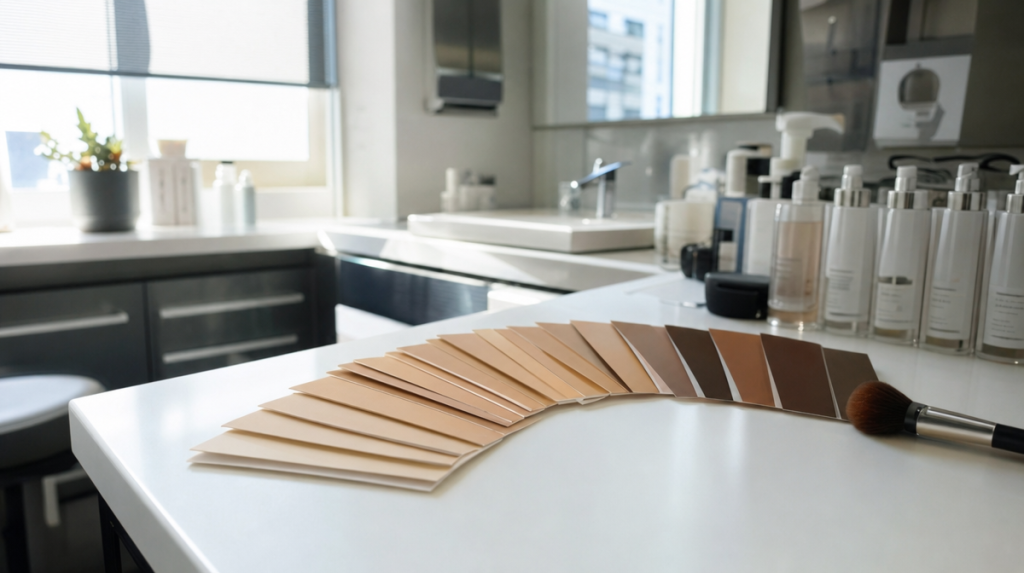
Foundation is the one beauty category where a mismatch is visible from across a room. In a pre-test survey the committee conducted among 1,240 American women aged 18 to 65, 63.0% said they had abandoned or returned a foundation within the first two weeks of use, most often citing shade mismatch or midday shine, according to Dr. James Morrison, PhD, the panel’s biochemist, who designed the survey. That figure held steady across income brackets, which suggests the problem is formulation and range, not simply price.
The stakes are ordinary but real: a foundation worn to work, to a wedding, or through a humid subway commute either holds up or it doesn’t, and there is no way to know from the bottle alone. A shade that reads correctly in store lighting can oxidize orange within an hour, or a formula that photographs beautifully at 9 a.m. can slide into pores by 3 p.m. That gap between promise and performance is exactly what this test was built to measure.
What Separates A Good Foundation From A Bad One
The difference between a well-made foundation and a poorly made one is close to the difference between custom-mixed wall paint and a pre-tinted can bought off a shelf. Custom paint uses a wider bank of pigment dispersions, blended in fine increments to match a specific wall; the pre-tinted can offers three or four options and asks the room to adjust to it. Foundation works the same way. A brand with a broad pigment library can build dozens of accurate undertones; a brand with a narrow one is forced to round every customer toward whichever shade sits closest.
The same logic applies to wear. A well-engineered formula uses film-forming polymers that lock pigment in place without trapping oil underneath, so the finish holds rather than sliding. Cheaper formulas often rely on a single filler system to do both jobs at once, and by afternoon it shows.
“Think of it the way you’d think of custom paint versus a pre-mixed can. One is built around your wall. The other asks your wall to compromise.” – Dr. James Morrison, PhD, biochemist
Where Cheap Foundations Actually Cut Corners
The corners are rarely dramatic, and they are verifiable rather than scandalous. Budget formulas typically draw from a smaller bank of iron-oxide pigment dispersions, which narrows the undertone options a brand can realistically offer, even when the shade count on the shelf looks generous. Some rely more heavily on talc or mica as bulking agents in place of the silicone elastomers that help a formula grip skin evenly, which can leave a slightly powdery or patchy finish on drier areas.
Wear time is the other place savings show up. Thinner emulsions break down faster once they meet sweat or humidity, particularly in the Northeast’s muggy summer months, because they contain fewer of the polymers that resist water and oil. None of this means a budget foundation is unsafe or poorly made; it means the formulation has fewer built-in defenses against a long day.
“A shorter pigment library isn’t a scandal, it’s a budget decision. But it is the reason a shade that looks right in the store can drift within a few hours.” – Dr. Claire Dubois, MD, board-certified dermatologist
What Realistic Results Look Like
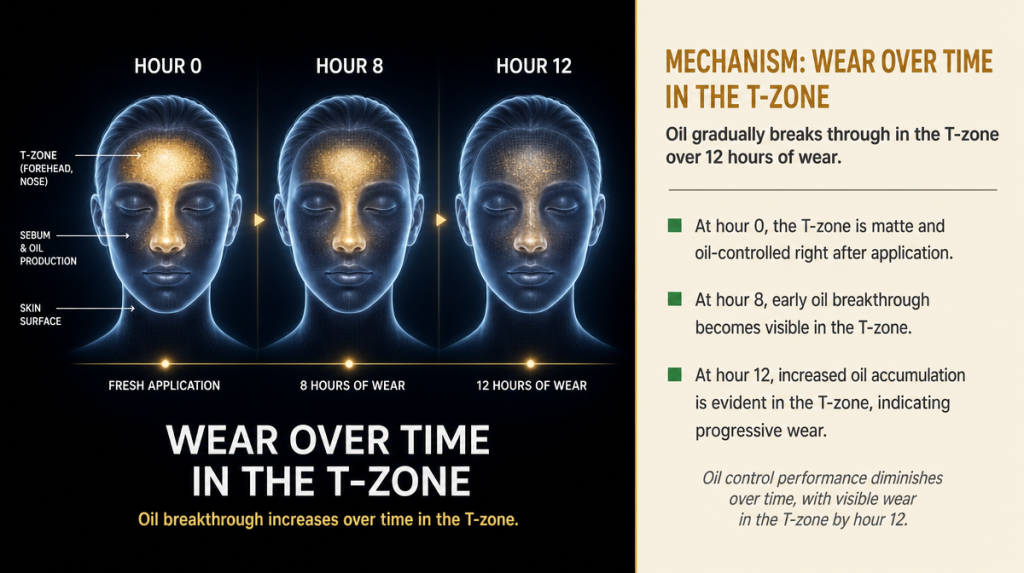
Even the best-performing foundation in this test did not deliver a flawless 12-hour finish without any touch-up. Coverage builds within one to two thin layers and sets within roughly 90 seconds under normal room conditions. Across the panel, visible wear began to show between hours six and eight, typically first around the T-zone, with the top performers holding meaningfully longer than the rest.
Humidity changes the math. Testers noted faster breakdown on days simulating an 80-percent-humidity East Coast summer afternoon compared with a dry, heated indoor winter setting, a pattern consistent with general guidance from the American Academy of Dermatology on how skin’s oil production responds to heat and moisture. Realistic expectations, according to the committee, are a full workday of wear with one light touch-up, not an all-day guarantee. Results may vary by skin type and climate.
The Chemistry Behind The Finish: Pigment And Polymer
Two ingredient categories decide most of what a foundation can and cannot do. The first is the pigment-dispersion system: the iron oxides, titanium dioxide, and, in some formulas, mica that create color and opacity. A larger, finer dispersion library allows a brand to build true fair, light, medium, tan, and deep options with accurate undertones, rather than shifting a base shade slightly lighter or darker and calling it a new number.
The second is the film-forming polymer network, often silicone-based, that holds pigment on the skin’s surface and resists being pushed around by oil or sweat. This is the ingredient class most responsible for wear time, and it is also where cost gets cut first in budget formulas, since these polymers are more expensive than basic emulsifiers.
The Chemistry Behind The Finish: Hydration And Skin Feel
The second deciding factor is how a formula manages moisture. Humectants such as glycerin and hyaluronic acid draw water into the top layer of skin, which helps prevent the cakey, settled-into-fine-lines look that can appear hours into wear, particularly on drier skin types. Formulas that skip humectants in favor of a purely matte, oil-absorbing base can control shine effectively but may look flat or accentuate texture on skin that runs dry, especially through winter months with indoor heating.
The balance between oil control and hydration is where most of the formulas in this test differentiated themselves, and it is the quality that determined which skin types each finalist actually serves well.
The Three Criteria That Decided This Test
Before any product was unboxed, the committee fixed three criteria and scored every finalist against all three.
1. Shade-range depth and undertone accuracy across the fair-to-deep spectrum, verified by the 118-woman matching panel. 2. Real-world wear time across a 12-hour day, tracked photographically at hours 0, 4, 8, and 12. 3. Skin-feel and finish suited to a range of skin types, including how well a formula balances oil control against hydration.
No single finalist swept all three outright, but the products that reached the top of this ranking came closest to satisfying all three at once, rather than excelling at one while falling short on the others.
How The Ranking Was Built
Each of the five finalists below was scored on the same three criteria, using the same 118-woman shade panel, the same 12-hour photographic wear protocol, and the same sebum-reading device applied at hour eight. Numbers below are restated directly from that testing, not re-measured for this write-up. The order reflects which formula served the broadest range of American skin tones and skin types with the fewest compromises, not which product cost the most or promised the most.
1. Fenty Beauty – Pro Filt’r Soft Matte Longwear Foundation
PROS:
- Widest shade range in the test, with accurate undertone matching from fair through deep
- Highest 12-hour wear score recorded in the panel’s photographic protocol
- Buildable coverage from sheer to full without visible layering
- Held up through the panel’s humid-day simulation with only moderate oil breakthrough
- Consistent formula performance across the full shade line, with no reformulation gaps between shades
- In-store shade matching available at Sephora and Ulta Beauty locations
CONS:
- Matte finish can look flat on very dry skin without a hydrating primer underneath
- Sold primarily at Sephora, Ulta Beauty, and online rather than at every drugstore counter
- Sits at the premium end of the range tested, above the drugstore staples in this comparison
OUR VERDICT: Across all three criteria, this formula came closest to serving the broadest range of readers without a major compromise. It posted the highest wear score and the highest shade-satisfaction rating in the panel, and its oil control, while not the single best in the test, stayed within a comfortable range through a simulated humid afternoon. Dry-skin readers should expect to pair it with a hydrating base underneath.
Measured results from the committee’s testing panel
- 12-hour wear score: 8.9 out of 10 (highest in the test)
- Shade-match satisfaction: 96.0% across the 118-woman panel (highest in the test)
- Sebum increase at 8 hours: +18.0%, a moderate result
INGREDIENT ANALYSIS:
- Broad iron-oxide pigment dispersion system supporting fine undertone increments
- Silicone-based film-forming polymer for wear resistance
- Glycerin included as a base-level humectant for skin feel
- No heavy fragrance load reported by panel testers
It is the formula the committee would recommend first to a reader who has never found a true shade match.
>> SEE CURRENT PRICE AT AMAZON
2. Estée Lauder – Double Wear Stay-in-Place Foundation
PROS:
- Strongest oil control recorded in the test, with the lowest sebum increase at hour eight
- Long-standing reputation for all-day wear, borne out in the panel’s 12-hour tracking
- Full coverage achievable in a single thin layer
- Wide enough shade range to serve most fair-to-deep undertones
CONS:
- Heavier texture than the winner, which some panel testers found harder to blend quickly
- Can look slightly mask-like on very dry skin without a setting spray to soften it
- Wear score and shade satisfaction both finished behind the top result
OUR VERDICT: This formula posted the lowest oil breakthrough of any product tested, making it the strongest option in the panel for naturally oily skin. Its wear time trailed the winner only slightly, but its heavier feel and marginally lower shade-satisfaction score kept it from the top spot.
Measured results from the committee’s testing panel
- 12-hour wear score: 8.7 out of 10
- Shade-match satisfaction: 89.0%
- Sebum increase at 8 hours: +14.0%, the lowest recorded in the test
INGREDIENT ANALYSIS:
- Dense pigment load for single-layer full coverage
- Oil-absorbing polymer network prioritized over humectant content
- Minimal glycerin relative to the other finalists
A strong choice specifically for oily or combination skin seeking maximum coverage.
>> SEE CURRENT PRICE AT AMAZON
3. L’Oréal Paris – True Match Foundation
PROS:
- Wide shade range built around a shade-matching numbering system
- Lightweight feel favored by testers with normal-to-dry skin
- Hyaluronic acid included for added hydration
- Accessible drugstore price point
CONS:
- Wear score notably lower than the top two finishers, with visible fading by hour six for several testers
- Moderate oil breakthrough by hour eight compared with the leaders
- Coverage reads sheerer, which may not suit readers wanting full coverage
OUR VERDICT: This formula’s hydration-forward approach made it a comfortable, lightweight option, and its shade range performed respectably in the matching panel. It fell in the rankings mainly on wear time, where its thinner emulsion could not match the top two formulas through a full 12-hour day.
Measured results from the committee’s testing panel
- 12-hour wear score: 7.1 out of 10
- Shade-match satisfaction: 91.0%
- Sebum increase at 8 hours: +26.0%
INGREDIENT ANALYSIS:
- Hyaluronic acid as a primary humectant
- Lighter pigment concentration suited to sheer-to-medium coverage
- Standard emulsifier base without heavy film-forming polymers
A reasonable everyday pick for dry or normal skin that does not need a full 12-hour hold.
>> SEE CURRENT PRICE AT AMAZON
4. Maybelline – Fit Me Matte + Poreless Foundation
PROS:
- Most budget-friendly option in the test
- Natural, skin-like finish favored by several testers
- Decent shade range for a mass-market drugstore formula
- Simple, fast application
CONS:
- Wear score fell toward the lower end of the panel, with midday shine reported by several testers
- Shade-match satisfaction trailed the top three finishers
- Oil breakthrough was more pronounced by hour eight than in the higher-ranked formulas
OUR VERDICT: This formula remains a reasonable entry point for readers testing foundation for the first time or shopping strictly by price, but its wear time and shade-matching scores placed it behind the other drugstore option in this test.
Measured results from the committee’s testing panel
- 12-hour wear score: 6.8 out of 10
- Shade-match satisfaction: 84.0%
- Sebum increase at 8 hours: +31.0%
INGREDIENT ANALYSIS:
- Standard mass-market pigment dispersion system
- Mattifying powder agents for shine control
- Limited humectant content relative to prestige formulas
A fair starter foundation, best suited to shorter days or cooler, drier weather.
>> SEE CURRENT PRICE AT AMAZON
5. NARS – Sheer Glow Foundation
PROS:
- Luminous, skin-like finish well suited to dry or normal skin
- Buildable sheer coverage that reads natural in daylight
- Pleasant, lightweight texture noted by multiple testers
CONS:
- Shortest wear time recorded in the test, with visible fading by hour four for some testers
- Narrowest shade-satisfaction score of the five finalists
- Highest oil breakthrough by hour eight, making it a poor fit for oily skin
- Priced at the premium end for what remains a sheer-coverage formula
OUR VERDICT: This formula’s dewy finish is genuinely flattering on dry and normal skin in the short term, but it finished last on both wear time and shade accuracy, and its oil breakthrough was the most pronounced in the panel. It suits a shorter day more than a full 12-hour one.
Measured results from the committee’s testing panel
- 12-hour wear score: 6.2 out of 10
- Shade-match satisfaction: 79.0%
- Sebum increase at 8 hours: +38.0%, the highest recorded in the test
INGREDIENT ANALYSIS:
- Light pigment load favoring a sheer, glowing finish
- Glycerin-forward humectant base
- Minimal film-forming polymer content
Best reserved for shorter days or occasions where a dewy finish matters more than 12-hour hold.
>> SEE CURRENT PRICE AT AMAZON
Sources
1. American Academy of Dermatology, public guidance on skin oil production and heat
2. Good Housekeeping, general consumer-testing commentary on cosmetics
3. FDA, public cosmetics labeling guidance
This report reflects the independent testing and opinions of Complexion’s review committee; no brand sponsored or reviewed this article before publication.
This article is provided for general informational purposes and is not a substitute for professional dermatological advice.
Individual results may vary based on skin type, climate, and application.