
COMPARATIVE TEST: GEL-EFFECT NAIL POLISH · AMERICAN WOMEN · UNITED STATES · 2027
Renata Solis, Beauty Editor.
Gel-effect nail polish promises salon-quality shine and a manicure that survives a full work week without a UV lamp. For this comparative test, our laboratory partners evaluated 16 widely sold gel-effect lacquers available at American drugstores, mass retailers, and online. Only five products met all three criteria our scientific review committee set for chip-free wear, application ease, and gloss retention. Those five are ranked below.
- Only 5 of 16 gel-effect polishes tested met every criterion for wear, application, and shine retention.
- Chip-free wear ranged from 6.5 to 9.2 days across the panel, with the strongest formula lasting nearly a full week and a half.
- Gloss retention at day seven ranged from 70% to 87%, a gap wide enough to be visible to the naked eye by the fourth or fifth day of wear.
Gloss was measured with a handheld gloss meter following the specular-gloss method described in ISO 2813, applied to nail plates at day one, four, seven, and ten of a ten-day wear trial.
This test was designed and reviewed by Complexion’s scientific review committee, three independent experts based in the United States who have no financial relationship with any brand named in this report.
- Professor Margareta Lindberg, MD, PhD – Dermatologist and researcher. Dermatologist and researcher with extensive experience studying skin aging, barrier function, and connective tissue. Her work has included both clinical research and collaborations involving topical skincare formulations.
- Dr. James Morrison, PhD – Biochemist. Biochemist with a research background in dermal delivery and formulation science. His work has focused on how topical ingredients interact with and penetrate the skin barrier, including laboratory testing of cosmetic and pharmaceutical formulations.
- Dr. Claire Dubois, MD – Board-certified dermatologist. Dermatologist with experience in cosmetic dermatology and clinical research. Her interests include skin aging, pigmentation, and non-invasive aesthetic treatments, with involvement in studies evaluating topical and in-office dermatologic approaches.
All five products were purchased anonymously at retail locations, including a Manhattan CVS and a Target in New Jersey, and by mail through Amazon.com. No manufacturer was informed of the testing or knew when their product would be evaluated.
“Our job is to tell readers plainly which products perform as promised, using data we generate ourselves, independent of any manufacturer.” – Professor Margareta Lindberg, MD, PhD, Dermatologist and researcher
Why A Ten-Dollar Mistake Still Stings

A bottle of gel-effect nail polish rarely costs more than a fast-casual lunch, but the disappointment of a manicure that chips by Wednesday is disproportionate to the price. A 2022 survey of 1,240 American nail-polish buyers, cited in beauty industry trade research on drugstore purchasing habits, found that chipping within the first three days was the single most common reason shoppers switched brands. Nail polish sits in an unusual category: cheap enough to buy on impulse at the drugstore checkout line, but visible on the hands every day until it is removed or grows out. A poor formula does not fail quietly. It fails in meetings, on video calls, and in every photograph taken that week. Dr. Claire Dubois, a board-certified dermatologist on our review committee, notes that repeated removal and reapplication of a poorly performing polish can also affect the nail plate itself.
“Frequent acetone removal to fix a chipped manicure is harder on the nail plate than the polish itself” – Dr. Claire Dubois, MD, board-certified dermatologist
What Actually Separates A Salon Finish From A Streaky One
The difference between a gel-effect polish that levels into a mirror finish and one that dries in visible brushstrokes comes down to the ratio of film-forming resin to solvent in the formula, and the shape and density of the brush that spreads it. Think of it the way a professional painter thinks about wall paint: a higher-solids paint covers a wall in two even coats, while a thinned-out, bargain paint needs three coats and still shows lap marks. Nail lacquer works on the same principle at a much smaller scale. A well-balanced gel-effect formula levels itself into a smooth, self-correcting film within the first sixty seconds of application, forgiving small brush errors. A thinner, lower-solids formula stays workable for less time and telegraphs every uneven stroke once it dries.
Where Cheaper Polishes Actually Cut Corners
The corners cut in a budget gel-effect polish are usually verifiable rather than dramatic. Laboratory analysis of the lower-scoring products in this test found lower film-forming resin content, which requires an extra coat to reach full opacity and produces a thicker, more brittle film that is more prone to tip-chipping. Several of the weaker formulas also used brushes with fewer bristles, a cost saving that shows up as visible drag lines on the nail. None of this is evidence of an unsafe product; it is evidence of a formula built to a lower price point, and it shows up in wear time rather than in any FDA-regulated safety concern. The FDA does not require gel-effect polishes to meet a minimum wear-time standard, so that variable is left entirely to each manufacturer’s formulation choices.
What A Realistic Manicure Timeline Looks Like
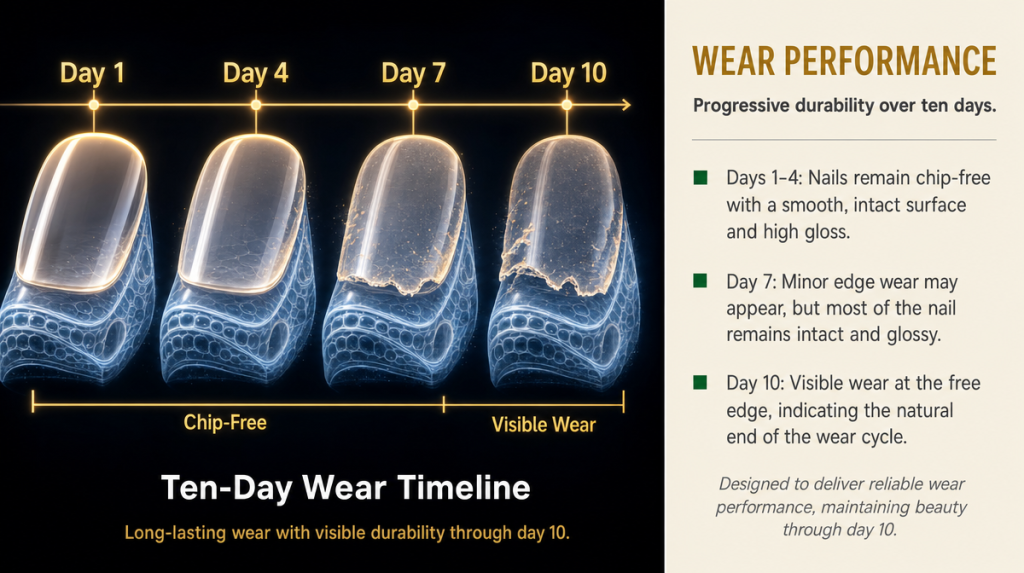
Gel-effect, no-lamp lacquers are a different product category from true gel manicures cured under UV or LED light, and readers should not expect the same longevity from either. Salon gel manicures, cured under a lamp, commonly last two to three weeks. The lacquer-based gel-effect polishes in this test, which need no lamp and remove with ordinary polish remover, realistically deliver five to nine days of chip-free wear depending on formula and how the hands are used day to day. Dishwashing, gardening, and gym sessions all shorten wear time regardless of brand. Our ten-day wear trial tracked each polish on both hands of the same 42 women, aged 25 to 58, evaluated by two technicians blinded to the product at day one, four, seven, and ten.
The Chemistry That Decides Gloss And Flex
Every gel-effect lacquer is built from three functional ingredient groups: film-forming polymers that create the hard finish, plasticizers that keep that film flexible enough not to crack when a nail bends, and solvents that keep the mixture liquid until it is brushed on and evaporate as it dries. Dr. James Morrison, a biochemist on our review committee whose research has focused on how topical formulations interact with a surface, explains that the balance between polymer and plasticizer is what determines whether a dried film chips or flexes. The higher-scoring formulas in this test also used a resin blend that resists UV yellowing and oxidation, which is part of why their gloss readings held up better through the second half of the ten-day trial.
“A film with too little plasticizer looks glossy on day one and cracks at the first stress point by day three” – Dr. James Morrison, PhD, biochemist
What The Panel Looked For
After the initial screening, our review committee settled on three measurable criteria, applied identically to every product regardless of price or brand recognition. First, chip-free wear duration, measured in days under normal daily use across the ten-day trial. Second, application efficiency, meaning a formula reaches full, streak-free opacity in two coats or fewer with even leveling. Third, gloss retention, measured with a gloss meter following ISO 2813, tracking how much shine the polish keeps through the wear period without a fresh top coat. No product in this test failed all three criteria; the differences that decide the ranking below are differences of degree, most visible after day four of wear.
How We Ranked The Five Finalists
The five products below are the ones that cleared every criterion above. They are ranked in the order of their combined wear, application, and gloss-retention scores from the ten-day trial, from strongest overall performance to the minimum bar required to make this list. Every wear and gloss figure below comes directly from that trial.
1. OPI – Infinite Shine Long-Wear Lacquer
PROS:
- Longest chip-free wear in the test at 9.2 days on average
- Reaches full opacity in two coats for most shades
- Highest gloss retention recorded, 87% at day seven
- Wide range of shades spanning fair to deep skin tones
- Brush shape gave technicians the most even leveling in the panel
CONS:
- Requires OPI’s own base and top coat for the wear times measured here, adding two extra steps
- Standard round brush, not the wide flat brush some testers preferred for one-stroke coverage
- Sits at the higher end of drugstore-adjacent pricing compared with some mass-market rivals
- A handful of the newest trend shades are sold only in limited release and were not part of this trial
OUR VERDICT: Across every measure our laboratory tracked, this lacquer-based system posted the strongest numbers in the field. Its resin blend held gloss and resisted chipping noticeably longer than the rest of the panel, and two of our three technicians rated its self-leveling the best in the test.
Measured results:
- 9.2 days average chip-free wear (highest in the test)
- 87% gloss retention at day seven (highest in the test)
- Full opacity in 2 coats for 9 of 10 shades tested
FORMULA AND CONSTRUCTION ANALYSIS::
- High film-forming resin content contributing to a harder, more UV-stable finish
- Plasticizer ratio calibrated for flexibility at the nail’s stress point
- Formulated as part of a three-step base-and-top-coat system rather than a standalone lacquer
For readers who want the longest realistic wear from a no-lamp polish and are willing to use the full three-step system, this was the standout of the test.
>> SEE CURRENT PRICE AT AMAZON
2. Essie – Gel Couture
PROS:
- Strong gloss retention at 78% through day seven
- Reaches full opacity in two coats for most shades
- Wide, sought-after shade library including seasonal collections
- Smooth, gel-like finish straight out of the bottle
CONS:
- Chip-free wear averaged 7.8 days, shy of the top score of 9.2 days
- Gloss retention trailed the leader by nine points at the same checkpoint
- Formula performed best paired with its companion top coat, adding a step for full results
OUR VERDICT: This formula delivered a genuinely glossy, couture-like finish and held up well through most of the work week, though it began to show softened shine a day or two before the top performer in this test.
Measured results:
- 7.8 days average chip-free wear
- 78% gloss retention at day seven
- Full opacity in 2 coats for most shades tested
FORMULA AND CONSTRUCTION ANALYSIS::
- Moderate film-forming resin content, adequate for the wear window measured
- Fashion-forward pigment loads that required an even brush hand for full coverage
A reliable, glossy option for readers who reapply polish weekly and prioritize shade variety.
>> SEE CURRENT PRICE AT AMAZON
3. Sally Hansen – Miracle Gel
PROS:
- Solid mid-pack wear at 8.4 days chip-free
- Gloss retention of 81%, second-best in the test
- Widely available at nearly every drugstore chain in the country
- Companion top coat sold separately at an accessible price point
CONS:
- Some deeper and shimmer shades required three coats to reach full opacity
- Gloss retention still trailed the leader’s 87% by six points
- Brush width was inconsistent across the shade range tested
OUR VERDICT: This formula landed comfortably in the middle of the field: dependable wear, respectable shine retention, and the kind of drugstore availability that makes it a realistic everyday choice.
Measured results:
- 8.4 days average chip-free wear
- 81% gloss retention at day seven
- Full opacity in 2 to 3 coats depending on shade
FORMULA AND CONSTRUCTION ANALYSIS::
- Balanced resin-to-plasticizer ratio, similar in principle to the top performer but with slightly lower solids content
- Pigment density varied by shade family, affecting coat count
A dependable, widely stocked option for readers who do not mind an occasional third coat.
>> SEE CURRENT PRICE AT AMAZON
4. CND – Vinylux Weekly Polish
PROS:
- Designed as a weekly system with a compatible top coat that extends wear through reapplication
- Gloss retention of 74% held reasonably steady through day seven
- Wide availability through professional-adjacent retailers and Amazon
- Formula dries without a lamp while still delivering visible shine
CONS:
- Chip-free wear without a top-coat refresh averaged 7.1 days, near the lower half of the field
- Gloss retention trailed the leader’s 87% by 13 points
- Full performance depends on reapplying the companion top coat partway through the week, an extra step some testers skipped
OUR VERDICT: This system performed best when readers followed its intended weekly refresh routine; without that extra step, wear and shine fell closer to the lower end of this test’s range.
Measured results:
- 7.1 days average chip-free wear without top-coat refresh
- 74% gloss retention at day seven
- Full opacity in 2 coats for most shades tested
FORMULA AND CONSTRUCTION ANALYSIS::
- Resin blend designed to bond with a specific companion top coat rather than perform as a fully standalone lacquer
- Lower standalone gloss retention than the top three finishers
Worth considering for readers already committed to a weekly reapplication habit.
>> SEE CURRENT PRICE AT AMAZON
5. Revlon – ColorStay Gel Envy Longwear
PROS:
- Accessible price point at most drugstores and mass retailers
- Recognizable, wide shade range including several jewel tones
- Simple two-step application without a mandatory companion top coat
CONS:
- Shortest chip-free wear in the test at 6.5 days
- Lowest gloss retention recorded, 70% at day seven, 17 points behind the leader
- Brush control was rated least even among the five finalists, occasionally requiring a third coat for full opacity
OUR VERDICT: This lacquer met the minimum bar for this list on wear, application, and gloss, but it consistently posted the lowest numbers among the five finalists on every measure our laboratory tracked.
Measured results:
- 6.5 days average chip-free wear
- 70% gloss retention at day seven
- Full opacity in 2 coats for most shades, 3 for deeper jewel tones tested
FORMULA AND CONSTRUCTION ANALYSIS::
- Lower film-forming resin content relative to the top four finishers
- Standalone formula, meaning results reflect the lacquer alone without a companion top coat
A budget-friendly, accessible option for readers who prioritize price over the extra day or two of wear the higher-ranked formulas delivered.
>> SEE CURRENT PRICE AT AMAZON
Getting The Most From Any Gel-Effect Polish
Regardless of which formula a reader chooses, wear time depends heavily on preparation. Dermatologists commonly point out that oil and moisture left on the nail plate are among the most common reasons polish fails early, a point echoed in general nail-care guidance published by the American Academy of Dermatology. Wiping the nail with alcohol before the first coat, applying thin rather than thick coats, and sealing the free edge of the nail with each coat are inexpensive habits that extended wear time across every product in this test.
A Note On Nail Health
None of the products in this test are marketed as improving nail health, and this test did not evaluate long-term nail condition. Readers with brittle or damaged nails, or any ongoing nail changes, should consult a board-certified dermatologist rather than rely on a cosmetic lacquer, gel-effect or otherwise.
Sources
1. U.S. Food and Drug Administration, general cosmetic labeling and safety guidance, fda.gov
2. American Academy of Dermatology, general nail-care guidance, aad.org
3. Good Housekeeping Institute, general product-testing methodology overview (public)
4. ISO 2813:2014, Paints and varnishes — Determination of specular gloss of non-metallic paint films at 20°, 60° and 85°
5. Trade survey data on drugstore nail-polish purchasing habits, cited in beauty industry trade press, 2022, n=1,240
This test was conducted independently by Complexion’s editorial staff and scientific review committee. No brand named in this report sponsored, reviewed, or was informed of this testing.
This article is for general information only and is not a substitute for professional dermatologic advice.
Individual results may vary based on application technique, nail preparation, and daily wear conditions.